Monday, November 26, 2012

THE SABA ARTICLE ON ARTIST MAKEMBA'S PRESENTATION.

THE SABA ARTICLE ON ARTIST MAKEMBA'S PRESENTATION.
JOUVAY LASSUPA

The  article below by Amon Saba Saakana, pulled at several things that interested me:
1. The idea of the house
2. The idea of the community that was presented by the Studio 66 community.
3. The deconstruction and reconstruction of the artists within community.
4. Revolutionizing the presentation of the product.

It is some thing that I have been in discussion with my colleagues for sometime now. On those Fridays or whatever afternoon that we sit or meet in conversation about the things that we do; how do we do it; why do it, why continue to do it (someday I will like to post something on the why we do this).

The presentation of Makemba's painting last Sunday presented part of the answer.

As artists' continue their negotiation for nurturing space with the state and the state's creation of the -

Trinidad and Tobago
Creative Industries Company.

I have always commented that we need to deconstruct the way we do and present our work  alongside the same vibration of  our own communities and other communities.

I have told Sean that when we see the prostitutes or the transvestites (who use the nearby park as their office and are practically his neighbours) sitting down in one of Alice Yard's many cultural conversations we know that we're doing something right.

Well you know that I can't speak about community without not mentioning The Sculptural Playground Project which will be my attempt to speak about the presentation of the artists' ideas in relation to communities and the role of -
ART-DESIGN.
in the re-formulation of how people interact with our work and the reconstruction of how the political, philosophical and economic system of the art/design product OPERATES.

WE NEED TO BUILD COMMUNITY ART-DESIGN ARCHITECTURE THAT RESPONDS NOT ONLY TO THE COLONIAL PAST, BUT TO SERIOUS PERSONAL HIS/HERSTORIES.

This was what I attempted to bring up at the artists' meeting the other day... the building of community, is as important to any activism as the intervention of protest. Just because we sit with leaders of stakeholders groups, does not means that we have a community. Building the community means that we need to look at the formula of what has happened in Makemba's exhibition and to what Saba has alluded to in his article. But we need to carry it one step further, which will be the creation of the symbolic architecture of that new meaning of what the house can be in community. History becoming the walls, walls morphing into symbolic historical didactism. This is what came out to me. If anyone knows Studio 66 - it is a living space, a heart beating centre of people that is open to new footprints and voices, connected to very interesting cultural purpose.

PLEASE READ.     

Makenbas's painting.
ah forget the name,
But you can go down there and check it out.


Artist Makemba Kunle Presents His Jouvay Lassuppa

By Amon Saba Saakana

Story Created: Nov 23, 2012 at 11:39 PM ECT

Story Updated: Nov 23, 2012 at 11:39 PM ECT

Jamaica jumped ship from the proposed federation and Trinbago followed with the infamous words of Dr Eric Williams, "one from ten leaves nought," and he too plunged this twin-island state into political separatism.

Politicians are not trained to govern; they receive their training in other disciplines and are programmed to control and dictate in a "democratic" process that is relaunched every five years, when they make a magical appeal to the population that has little to do with reality than with winning votes. In any other profession they would have been justifiably characterised as "con" men and "charlatans."

But there is no union, governing body, for redress from malfunctioning politicians as there are for lawyers and doctors.

What does all this vitriolic prologue have to do with art and particularly that of Makemba Kunle?

Unknown person,Peter Minshall (artist/designer), Vel Lewis, another unknown person.
sorry  


The present "exhibition" titled Jouvay Lassuppa mounted at Studio 66, Barataria prominently featuring the new work of Makemba Kunle has also subtly interwoven into the working fabric of the production a Pan-Caribbean, Pan-African workforce.

The architectural designer of the space is Makemba's Jamaican son-in-law, architect/designer Lionel Spence, aided by his Jamaican colleague, Kemar Rodney.

Spence not only designed the project but oversaw the implementation of his design ideas with builder Ukambi.

Some of his art workers included Turunesh (Ethiopian), Bill Trotman, Barry Walkins, Rafiki Morris (African American), Bandele (UK/Trinbago) and Nigel Parris who constituted the core.

These were augmented seasonally by Congo, Eddie Romany, and concretised by the skillful management of "diplomat" Babu Ketema, a diffident arts worker who subsumes the "cause" better than most, and Onika.

Also included were stones collected by Congo from Grand Reviere to create a design, which, in the end, was an ancestral shrine, with sculptured clay heads of humans and animals as the surface of the sacre funerary space and the soft drippings of a waterfall. There was also bamboo cut in differing lengths to create a natural environment for hanging pictures, plastic sheeting which covered coloured plastic strips as screen, etc. a number of art pieces was also specially created to complement the locus of the exhibition with abstract painted motifs and dressed figures, cups, glasses, ceramic pieces, etc.

The cumulative effect of this monumental effort is that it reverts atavistically to the African tradition in which art is not seen as an expression of the separated individual but from the collective consciousness of the community.

Traditional house building in Africa, as well as royal and noble art, is done this way, thus an "exhibition" may well be the wrong choice of word to describe what this spectacle represents.

Naturally, the work of Makemba Kunle is central to the spectacle but the environmental device of location is what is so stimulating and unusual for art houses in Trinbago.

This undoubtedly has revolutionised art presentation in our artistic environment, and may well lead to the development of a new aesthetic which is located in the honouring of ancestors as mediative force in our proceedings, since it is our ancestors upon whose testable contributions to our living space we have inherited and inhabit.

Makemba Kunle as artist has been groping towards realisation of a form of artistic expression that could structure his creative intuition and unresolved spiritual ambivalence.

In this production, the result of two years work, he has finally realised what was before an unresolved intuition. He has now standardised an impressive set of work (70) which is organically linked by themes peopled by signs, molecular perception of the cosmos and the translation of spiritual intuition, and runs through the space to two adjoining houses.

How is this realised?

Kunle's work incorporates lines not as a central design element as in the work of others but as an indecipherable artifice in the construction of his universe. Lines represent concrete reality: buildings and earth creatures.

Kunle's initial point is the point of the dot, as in the art of house painting among southern african women. The dot is infinite and non-linear while the line is earthly and of a limited horizon.

The dot connects billions in an expanding universe, invisible but tangible under a microscope or spiritually intuited.

This sets this art up as a connective, interactive, communing experience (jouvaylassupper).

Though the human eyes cannot penetrate into our atmosphere, it is nevertheless made up of molecular structures (the core of our universe) and electromagnetic waves that may influence moods and natural phenomena (the moon moves water, for example).

These are perceptually expressed by the artist as a series of dots that are seen to people every organic form of our universe. in the articulation of this science of art or art of science.

Kunle has also expressed levels of consciousness through communication of signs. Peter Minshall, master designer, alluded to the relationship between community and communication in his delivery at the opening of the exhibition.

Signs are primordial markers of humanity through the ages communicating to others ideas of perception and apprehension, of experience.

Spiritual intuition is bound up with the unexplainable phenomenon that occurs through dreams, coincidences, diverse yet linked pathways, visitations, sensing of concrete reality yet expressed subliminally.

All these considerations are central to the realisation of self in community and communion, the sharing of a drink, food, the giving of a gift, the acceptance and giving of unsolicited advice, the single act that is experienced ephemerally yet constituting a new departure and development in the artistic psyche. Community and communication are twin placentas of distillation of consciousness, of shared journeys, of nebulous or pivotal links.

Politicians cannot fathom a journey that does not necessarily culminate in the amassing of monetary rewards, but the artist, striving for community, working towards a holistic and re-engineered selfhood, can be used as a measure of nudity before god and humanity and evokes and conjures up the image of the philosopher-priest which only the truly gifted and the truly cleansed can stake a claim to and dare to call into being.

The exhibition continues till December 9 and is open from 10 a.m. to 6 p.m. daily. Studio 66 is located at 66 Sixth Street, Barataria.


Tuesday, November 20, 2012

THE CULTURAL POLICY, THE CREATIVE INDUSTRIES COMPANY, THE ARTISTS AND THE SCULPTURAL PLAYGROUND PROJECT


Young man running through the obstacle course.
Sculptural Playground Project(c)


THE CULTURAL POLICY,
THE CREATIVE INDUSTRIES COMPANY,
THE ARTISTS
AND
THE SCULPTURAL PLAYGROUND PROJECT.

HERE ARE LINKS TO THE BUDGET INITIATIVES THAT WERE VANISHED TO MAKE TRACKS FOR DEREK CHIN AND BUSINESSMEN TO RUN:


LETS START HERE.
(WHAT DE F*#K IS
FALL WINTER -these dam middle class)
WITH THIS
CUT OUT FROM ONE OF OUR POPULAR DAILIES.

IT IS HOPED THAT THE CULTURAL POLICY WILL BE ABLE TO DEAL WITH THIS SPIRALING DECAY OF OUR PERSONAL
INTELLECTUAL,
AND
POLITICAL INDEPENDENCE
WE LIVE ONE FOOT HERE AND PSYCHOLOGICALLY IN THE OTHER WORLD.

WE HAVE LOST IT.

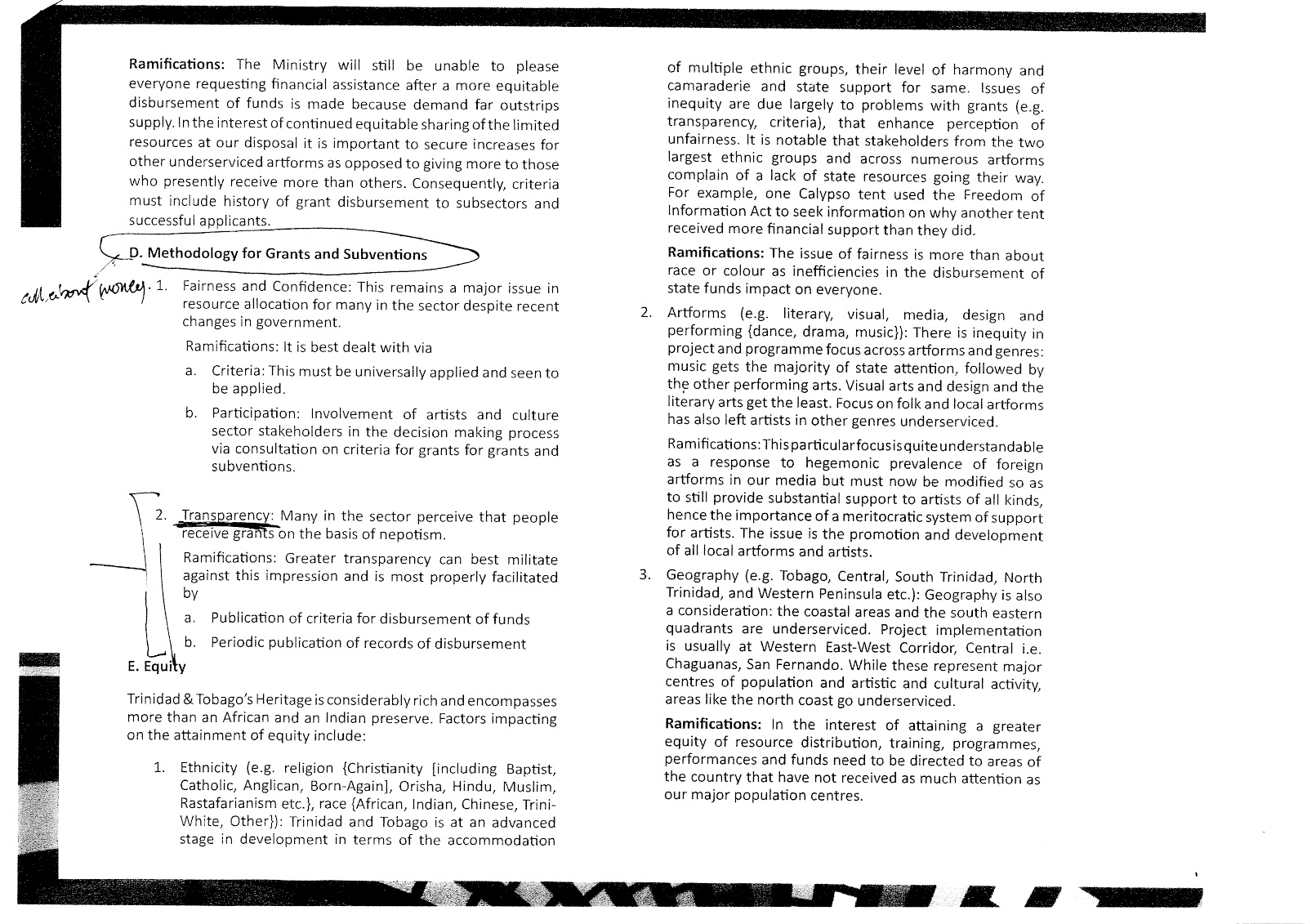
READING THE CULTURAL POLICY.

IT IS NO WAY ADDRESSING THIS

THIS CULTURAL POLICY NEEDS A SPINE.

IN
ENTITLEMENTS - 1, 4, 5, 6 
AREA OF FOCUS - 3, 4
METHODS - 7-C - 3-B

HAVE MENTIONED EDUCATION.

BUT IT REFUSES TO MENTION WHAT THIS EDUCATION WILL LOOK LIKE.

HOW IT WILL OPERATE
IN DEVELOPING THE KIND OF SKILLED CULTURAL WORKER WE WANT.

AS IT IS NOW THERE IS RANK IGNORANCE THAT EXIST IN THIS SPACE.

THE CULTURAL POLICY AS IT IS,
DOES NOT WANT TO RECTIFY THIS.

I WENT TO THE SCIENCE, THECNOLOGY POLICY CONSULTATION AND THEY MENTIONED THAT IN THERE CONSULTATION WITH OTHER STAKE HOLDERS, THEY HAVE RECOGNIZED THE IMPORTANCE OF EDUCATION IN DEVELOPING AN INNOVATIVE SPACE.

AT THE CULTURAL POLICY CONSULTATION THEY MENTIONED THAT THEY DON'T WANT TO STEP ON THE TOES OF OTHER INSTITUTIONS.

WE NEED TO STATE THAT IF THE POLICIES THAT ARE BEING PUSHED AT THIS TIME.
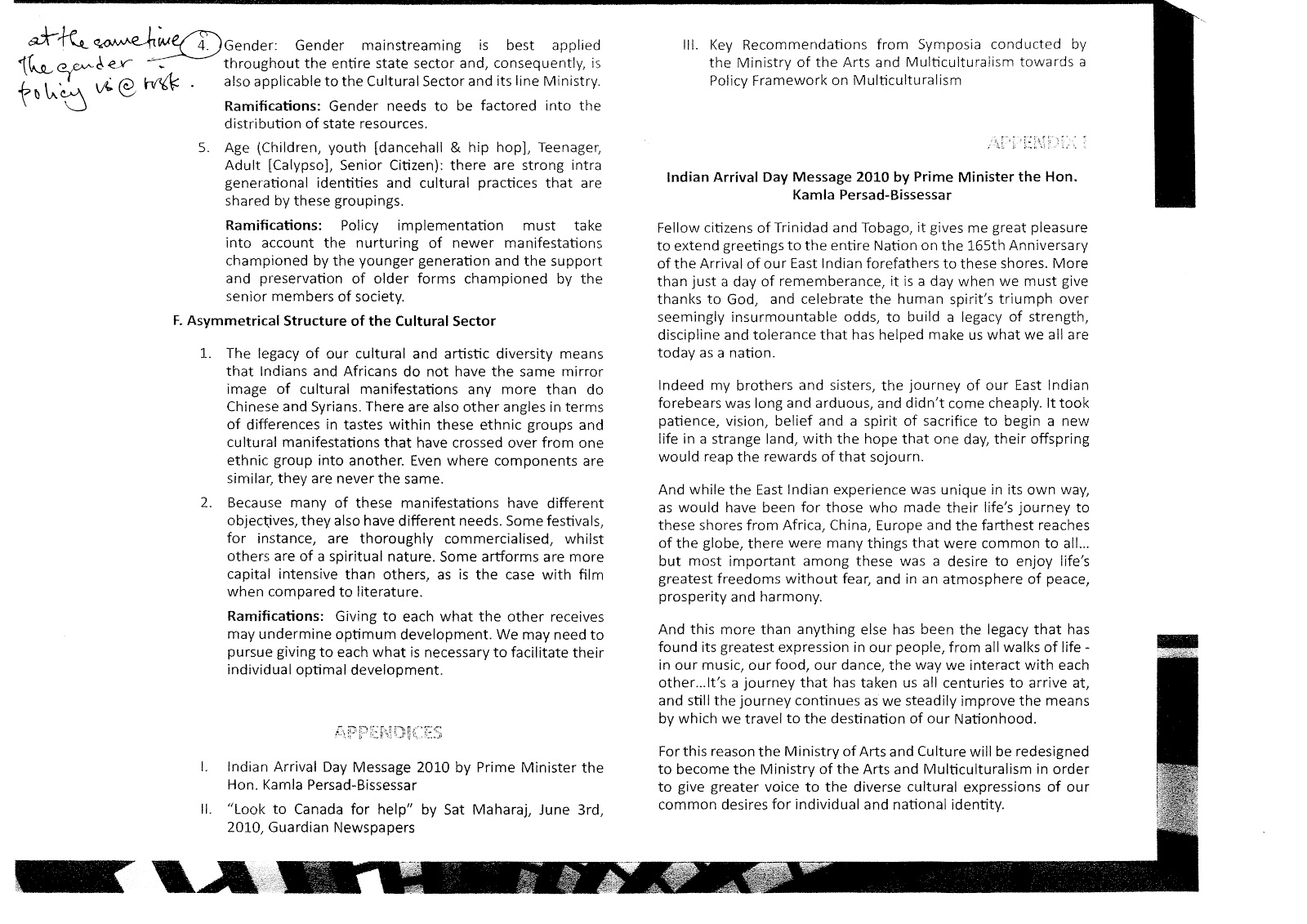
THE GENDER POLICY,
SCIENCE AND TECHNOLOGY POLICY,
THE ENVIRONMENTAL OR FORESTRY POLICY
(WHICH WAS HELD IN SOUTH),
THE CULTURAL POLICY.

PRESENTS THAT EDUCATION IS AN ALL IMPORTANT ISSUE FOR OUR DEVELOPMENT.

THEN EDUCATION WILL HAVE TO ADDRESS THE ISSUE OF
EDUCATION

HUMAN EDUCATION

NOT THIS PASS AH EXAM KINDAH TING
DAT PASSING FOR
EDUCATION HERE.


THIS WAS TAKEN FROM NEWSDAY SECTION B,
TUESDAY NOVEMBER 28, 2012.
PAGE 15.

THIS TELLS THE VERY STORY OF EXCLUSION,
DISINTEREST,
PROCESS
AND
POLITICS.
"persons desirons of commenting on the issue can do so on the charlotteville beachfront movement facebook page (google)"
 
 
THE ARTIST MEETING

Monday the 19th November 2012, I sat in the Little Carib Theatre, where I listened to the unfolding drama that sits at the door steps of the artists community. I listened to the soap opera of political intrigue, ambition, mobilization and betrayal. I listened to the sweat that artists have committed to the development of cultural structures  being cut out from under their feet, artists being threatened and hustled to abandon their post, abandon their artistic children, their dreams.

The stories that came, isn’t new ... its been here ever since.

Yesterday on the radio I listened to a caller speak about the exclusion of the originator of the original proposal for the job fair, WHICH WAS HELD IN THE SAVANNAH
 That day I’m also hearing about political exclusion.

I have heard the same story from crafts men apply for loans, that their loans will go through only of they consider bringing in one of the bankers friends as an investor.

I have listened to the story of artists who have given up their ideas only to see their loan application be denied and their idea manifest under strange circumstances under another name.

But hearing it now in this collective whole sale way from the state conglomerating everything under the guise of national patrimony in some form of capitalization and mutual benefit for the artists is very problematic and smacks at the heart of reverse slave trade/indenturship.

The idea of the body doing the work, while a business elite profit from the back, sweat, blood, intellectual and political sovereignty of artists under the guise of the Creative Industries Company.

IS CAPITALIST SLAVERY.


ah HEARING WORDS LIKE
INDEPENDENCE OF ARTISTS,
SUSTAINABILITY,
BUSINESS  MODEL ETC.
STRATEGIC,
NEGOTIATE,
EAT AH FOOD,
EAT DE FOOD,
TAKE DE FOOD,
THE BUCK STOPS HERE,
THERE WITH THIS
CREATIVE INDUSTRYCOMPANY
TING.

THIS IS SERIOUS ON ALL LEVELS.

IF WE'RE TO BUILD A CIVILIZATION WE MUST UNDERSTAND PROPER
PROCESS IN REACHING 
DESIGN DEVELOPMENT.
DESIGN BUSINESS.
 DESIGN INDUSTRY.

The artists who make it,
who feel they make,
they say that they built this without
state or any other economic involvement or third party situation.

that artists need to be independent and not rely on the state to eat ah food.

Must know, that is your story!
that isn't the story of
the other person.

one of the reasons for the creation of the Credit Union, was to offer alternatives.

Government
has a right to foster a fertile environment that will create the artists that will rise to their fullest potential.
to be independent,
to build without any third party help.

we deserve that!

THE BUSINESS COMMUNITY GET TAX BREAKS,
THEY GET INDUSTRIAL PARKS,
THEY GET VENTURE CAPITAL,
LOANS ARE WRITTEN OFF.
APPLE GET AN ENVIRONMENT THAT ENCOURAGES,
DEVELOPS.

WE DON'T!

SO LETS
UNDERSTAND WHAT WE'RE ASKING FOR.

AN ENVIRONMENT
WHERE MARLON
WILL DEVELOP AND BUILD HIS DESIGNS IN A SUPPORTIVE NURTURING SPACE,
INDEPENDANTLY,
SUSTAINABLY.

WHERE RICHARD CAN BUILD HIS MEGEE SCULPTURE.

WHERE DEAN CAN DEVELOP THE R&D SPACE.

HUMAN EDUCATION=ART/DESIGN
ART/DESIGN=PRODUCT
PRODUCT=MARKETING
MARKETING=ECONOMICS
ECONOMICS=DEVELOPMENT.

DEVELOPMENT SHOULD BE HUMAN NOT STATE. 


FORM IS IMPORTANT.
WE CANT JUST START AS AH BIG MAN AND EXPECT TO MAKE PROPER IN ROADS.
WHAT WILL HAPPEN IS THE ABOVE.
OUR PROCESS IS TO PILE, THINGS ON TOP OF EACH OTHER IN THE HOPE THAT WE WILL GET COVERING.

WE NEED PROPER FORM AND PROCESS.
 THAT ISN'T TO SAY THAT WHAT WE SEE ABOVE DOESN'T HAVE THE PROPER DESIGN PROCESS THAT WILL MAKE IT STAND THE TEST OF TIME.


THE CULTURAL POLICY CONSULTATION.
Held at the Centre of Excellence.


THE SETTING HAD ONE
BANANA,
GRAPES,
KIWI

LOCAL CONTENT POLICY WILL STATE THAT THERE ARE
A BANANA,
AH MANGO,
AH GRAPE.


Thursday, October 25, 2012

POLICY - A National Science and Technology Policy for Trinidad and Tobago


THIS POLICY DOCUMENT HAD CERTAIN GRAPHS LEFT OUT AS THEY WOULDN'T TRANSFERS BUT YOU WILL GET THE IDEA OF WHAT THE POLICY WANTS TO FOSTER AND THAT IS INNOVATION AND CREATIVITY.

iT ALSO STRIVES TO CREATE A PRIVATE + STATE PARTNERSHIP IN THIS RELATIONSHIP.

SOME OF THE IDEAS THAT CAME OUT OF THE CONSULTATION.


1. TRANSPARENCY, SHARING OF INFORMATION AND EDUCATION THAT WILL DEVELOP THE SOCIAL AND CRITICAL THINKING IN OUR PEOPLE.


2. EDUCATION FOR ONE - WHICH STATES THAT EDUCATION SHOULD BE TAILORED TO SUIT EACH STUDENT.


3. IT WAS UNDERSTOOD THAT INNOVATION COMES FOR THE PEOPLE. WORKING PEOPLE. THE HIGHER INSTITUTIONS ARE THERE TO REFINE INNOVATION.


4. THE IDEA THAT BOTH POLITICAL PARTIES SHOULD SIGN THE POLICY AS A NATIONAL POLICY. TO AVOIDE THE DISCARDING AND WASTAGE OF EFFORT WHEN ANOTHER PARTY TAKES THE REIGN OF GOVERNMENT. AS THEY HAVE DONE IN JAMAICA.

5. THERE SHOULD BE CLEAR TIME LINES. COMMITMENT TO THESE TIELINES.

6. THERE WAS A CONCERN ON THE FORMATION OF THE BOARD THAT WILL LOOK AFTER THE FUND. WHO WILL MAKE UP THE BOARD.
      A -THE QUESTION THAT ANY DEVELOPMENT OF INNOVATION SHOULD BE DEVELOPED FOR THE INTERNATIONAL MARKET AND BE ABLE TO BRING BACK RETURNS TO THE COUNTRY.
     B- THE FUND SHOULD SUPPORT IDEAS THAT CAN BE SUSTAINED TO MARKET.
     C- THE FUND MUST ALSO DEVELOP JUST EXPLORATORY IDEAS JUST FOR THE SAKE OF EXPLORATION AND DEVELOPMENT.

7. USE OF OUR DIASPORA, THROUGH THECNOLOGY WE CAN USE THEIR MINDS AND NOT THEIR BODIES.


A National Science and Technology Policy for Trinidad and Tobago
Consultative Document
Robert Martinez
and
Andrew Pierre,

NIHERST ABSTRACT

This document will serve as the basis for discussion and consultation in the development of a national science and technology policy for Trinidad and Tobago. It introduces the local science and technology landscape, outlines major policy areas and objectives, and identifies themes for discussion and consultation.


Introduction
The Government of Trinidad and Tobago, in its Medium-Term Performance Framework (MTPF), has identified economic diversification as a key aspect of overall national strategy. An important part of this strategy is to develop a knowledge-based economy, which has strong capabilities in new, high value-adding industries, such as information technology, high-tech manufacturing, agro-processing and pharmaceuticals, among others. The MTPF is arranged into seven pillars, and pillar 5 - A More Diversified, Knowledge Intensive Economy ¡V focuses specifically on creating a knowledge-based economy. To this end, the National Institute of Higher Education Research, Science and Technology (NIHERST) has been mandated by its line ministry to develop a National Science and Technology Policy, in accordance with Government¡¦s development strategy. This document should be viewed as a tool for public consultation and discussion, which will chart the course for national policy development. This consultative document is laid out in the following manner:
Section 1 gives a brief overview of the national science and technology landscape, and introduces the major science and technology issues affecting Trinidad and Tobago, and outlines some long-term objectives of the policy.
Section 2 goes into more depth on each of the major science and technology issues that are relevant to Trinidad and Tobago, giving a discussion of their role in national development and an outline of some available policy options.
Section 3 highlights some key issues for discussion, in order to stimulate thought and glean perspectives from all stakeholders. The chapter also identifies next steps, to follow from the national consultations.


Overview and Objectives

1.1: Local Science and Technology Landscape
In Figure 1 below, Trinidad and Tobago¡¦s ranking on the Global Competitiveness Index has declined from 76th in 2006 to 81st in 2011,

with the country attaining its lowest score (92nd) in 2008.
However, the country still ranks far lower than its regional neighbour, Barbados, which ranked 42nd in 2011. Since 2008, Trinidad and Tobago¡¦s GCI ranking has been showing some positive movement.

Science and technology issues1 comprise nearly one-third of the national score on the Global Competitiveness Index. As a result, the implementation of a successful National Science and Technology Policy has the capacity to transform Trinidad and Tobago¡¦s economy and society.
1 This is due to the influence of the Ministry of Science and Technology (MST) and the Ministry of Tertiary Education and Skills Training ( MTEST) on areas including higher education and training, labour market efficiency, technological readiness and innovation.
Trinidad and Tobago, Barbados, Jamaica, Singapore.


Figure 1 - Global Competitiveness Index rankings of Trinidad and Tobago and comparator countries, 2005-2011.

Figure 2 below shows Trinidad and Tobago¡¦s major strengths and weaknesses with regard to science and technology, based on the 2011 Global Innovation Index.
Figure 2 ¡V Trinidad and Tobago¡¦s Innovation Strengths and Weaknesses. Source: Global Innovation Index, 20112.
Trinidad and Tobago shows reasonable institutional strength, a relatively flexible labour market, low business start-up costs, a high proportion of engineering graduates, and strong investor protection. The ¡¥weaknesses¡¦ column shows that there is great room for export growth in computer and communication services, creative goods, and high-technology industries3. 1.1.1 Research and Development (R&D) R&D expenditure in Trinidad and Tobago grew from TT $35.1 million in 1996 to TT $65.8 million in 2009, peaking at $94.62 million in 2005, as shown in Figure 3 below. On average, such annual investments in R&D represent approximately 0.05% of Trinidad and Tobago¡¦s Gross Domestic Product (GDP). In comparison, the average R&D-to-GDP ratio in advanced nations is around 1.5%, with countries like Israel (4.2%) and Japan (3.3%) leading the way.
2 The Global Innovation Index was developed by the global business school INSEAD, in partnership with the World Intellectual Property Organisation and the Confederation of Indian Industry, and is published annually. 3 High technology industries are defined as industries where average R&D expenditure exceeds 7% of revenue.

National R&D expenditure (TT $m), 1996-2009
Source: NIHERST Annual Survey of Science and Technology Indicators.

 ¡V Trinidad and Tobago¡¦s Research and Development Expenditure, 1996-2009. 1.1.2 Patenting With regard to patenting activity, Trinidad and Tobago lags behind technologically advanced countries. The Global Innovation Index ranks Trinidad and Tobago 93rd with regard to patent applications at the local patent office, and as Figure 4 shows, there is a significant gap between the country¡¦s output of registered patents and that of Singapore, a small, technologically-advanced nation.
Figure 4 ¡V Total Patents Granted, Trinidad and Tobago vs. Singapore, 2005-2009.


Total patent grants include patents granted to overseas residents and multinational companies. Another strong indicator of technological capacity is in the quantity of patents granted to residents of a country. Trinidad and Tobago again shows a very low level of activity. This stark reality is brought into view when the country is compared with Singapore, in Figure 5 below4.

Sources: Intellectual Property Office (T&T), Intellectual property Office of Singapore.

Figure 5 - Patents Granted to Residents, Trinidad and Tobago vs. Singapore, 2005-2009. 1.1.2 Higher Education


According to the 2011 Global Innovation Index (GII), Trinidad and Tobago is graduating a very large proportion of its tertiary students in engineering5 and science6. There has been significant progress in increasing the quantity and quality of human capital in the areas of interest to local S&T policy-makers7. However, there is always further room for improvement in the tertiary education sector. According to the recently approved Tertiary Education Policy of the MTEST, the tertiary enrolment ratio surged from 15% in 20048 to 40% in 2008 due to the impact of the GATE programme, and MTEST has set a target of 60% enrolment by 2015. 1.1.3 Technological Readiness
Trinidad and Tobago ranks in 52nd place on the Technological Readiness sub-category of the 2011-2012 Global Competitiveness Index. Some areas in which Trinidad and Tobago has made
5 19.24% on data from 2004, ranked 11th. 6 11.15% on data from 2004, ranked 20th. 7 If the most up-to date (2009) figures on the local tertiary education sector were used, T&T would be ranked 4th in terms of the proportion of science graduates (16.2%) and 11th in the proportion of engineering graduates (18.4%). 8 The GII tertiary enrollment ranking is based on 2005 data. If the most up-to-date (2010) figures were used, Trinidad and Tobago would be ranked 55th.

Patents Granted to Residents
Trinidad and Tobago vs. Singapore, 2005-2009
T&T Resident Patent Applications
Singapore Resident Patent Applications
Sources: Intellectual Property Office (T&T), Intellectual property Office of Singapore.

progress - at least from the consumption and infrastructure side ¡V are in mobile phone and Internet penetration. Access to mobile phones is quite high9, and Internet access is on the rise, with nearly half the population having internet access as of 201010.
Figure 6 - Mobile cellular subscriptions (per 100 people) in Trinidad and Tobago, 1999-2010.
Figure 7 ¡V Internet subscriptions (per 100 people) in Trinidad and Tobago, 1999-2010.
9 147 mobile subscriptions per 100 people in 2009.

10 From 0.2% in 1995 to 36.3% in 2009.


Internet usage in Trinidad and Tobago, 1995-2010
Internet users (per 100 people)
Source: World Bank, World DevelopmentIndicators.
8
Figure 8 ¡V Broadband internet subscriptions in Trinidad and Tobago,


2001-2010.
However, mobile and broadband internet access are still fairly low,11 relative to total mobile and internet penetration ¡V as a result, these are areas with great scope for expansion. The internet is fast becoming a general purpose technology. A wider spread of high-speed access could lead to new economic opportunities, with the potential for rapid expansion in software development and web services, for example.
Figure 9 ¡V Comparison of broadband internet subscriptions and total internet subscriptions in Trinidad and Tobago, 2002-2010.
11 10.81 subscriptions per 100 people in 2011.


1.2 Objectives
The long-term goals of a science and technology policy for Trinidad and Tobago could be:
To increase the quantity and quality of national scientific and technological outputs; and
 To see these outputs lead to improved quality-of-life outcomes for T&T nationals and residents.
In the commercial sphere, outputs and outcomes could include:
 A diversified base of well-capitalised, profitable, high value-adding companies;
 Significant increases in manufacturing exports, especially in the medium- and high-technology sectors;
 Sustainable employment and competitive incomes for talented, well-trained citizens.
In academia, these outputs and outcomes could include:

 A consistent stream of high-quality publications;
 Prize-winning research projects; and
 The growth of world-class research units in a number of areas relevant to national development.
For the wider society, outputs and outcomes could include:
 Discovery and implementation of more efficient and effective solutions to national problems, such as flooding, road deterioration, traffic congestion, etc.

Sustained, productive research into prevention and treatment of major medical illnesses, such as Diabetes, Alzheimer¡¦s, etc.
However, long-term output and outcome targets of this nature will only be achieved if there is a successful medium-term science and technology strategy, in which the requisite inputs and capabilities are acquired and developed. Significant investment is required, not only in physical infrastructure such as equipment, Information and Communication Technologies (ICTs) and transport, but also in complementary and intangible assets.


Section 2: Major Issues
Based on the national science and technology landscape outlined in Section 1 above, the following major issues have been identified:
 Economic Diversification

 Human Capital Formation
 Building ¡§Brand T&T¡¨
 Inclusive Development.


2.1 Economic Diversification

The Government of Trinidad and Tobago has made economic diversification a significant priority, and it sees science and technology playing a key role in the diversification process. A major aim of government policy is to foster the growth of high-value industries, to complement the traditionally competitive resource-based economy from which Trinidad and Tobago derives its wealth. In order to achieve this aim, significant investments could be made to drive research, business, education, environmental awareness and public goods, among others. The instruments used to promote science and technology could be similarly varied, with a mix of targeted public spending, debt, equity, and venture capital used in appropriate situations to achieve maximum social returns. Given that both public and private R&D spending is crucial to a country¡¦s economic prospects, it is likely that Trinidad and Tobago will need to undertake significantly more R&D investment to achieve its goals. A potential medium-term target for this key action area is a national R&D expenditure level of at least 1% of GDP by 2017.

The Government has also identified the use of ICT as a key driver of economic growth and diversification. Trinidad and Tobago¡¦s ICT landscape has changed dramatically during the decade from 2001-2010, as adoption of technologies such as mobile phones, GPS and the internet have risen substantially over that period. More recently, the E-Connect and Learn policy was launched in September 2010, with the goal to supply all new secondary school students with laptop computers. Some initiatives to promote economic diversification and technology transfer could include:
Expanding the Research and Development Facility: Currently, there exists a Research and Development Facility (RDF) within the Ministry of Trade and Industry, which aims to provide financial support to businesses that wish to carry out R&D projects. The Facility has a low base of funding, and needs to be expanded significantly in order to achieve critical mass. Many innovative projects in science and technology may be too risky to attract funding from traditional sources such as banks. It is the role of government to intervene and provide financial and other forms of support, so that these economic opportunities are not wasted, especially when the rewards from successful projects benefit the whole society in the form of employment, exports and economic diversification.

Attracting investment from at least one more major company in the global ICT sector: Trinidad and Tobago can offer several investment advantages to potential investors, including an increasingly large pool of well-trained computer science and software engineering graduates, cheap energy, an open business environment, and a convenient Anglophone location in the Americas. Upgrading Trinidad and Tobago¡¦s mobile and broadband network infrastructure: If Trinidad and Tobago is to build a strong ecosystem for ICT-driven enterprises, it will require large public investment in network infrastructure, in order to ensure that the flow of information is fast, reliable and secure. In a highly competitive global market, downtime suffered due to failed connections, breaches of security, or spotty service can make the difference between survival and failure for small start-up companies. Therefore, government must ensure that cutting-edge communication technologies must be available to both businesses and consumers throughout Trinidad and Tobago. Establishing a Technology Transfer Office in Trinidad and Tobago: Technology Transfer offices (TTOs) are a tool that universities and governments use to identify research in science and technology that has significant commercial potential. By utilising a combination of scientific knowledge, economic decision-making, and a strong network of contacts, a TTO can be a powerful driver of research commercialisation and economic development. The World Intellectual Property Organization gives advice on the establishment of Technology Transfer Offices.


Technological Upgrading in Singapore The Local Industry Upgrading Programme (LIUP) is a method used by Singapore¡¦s Industrial Development Agency to accelerate the process of technology transfer, and to ensure that the benefits of foreign investment are shared in the local economy. Multinational companies operating in Singapore are given incentives to enter into long-term supply contracts with local firms and to offer them support in advancing their product and process technologies. The programme supports the secondment of MNC employees to local firms as a method of improving the competitiveness of local firms. This programme has recorded several success stories, especially in the ICT sector. For example, as Seagate and other large US companies relocated production to Singapore in the 1980s and 1990s, co-investment under the LIUP introduced technologies such as computer-aided design (CAD), computer-aided manufacturing (CAM) and computerised supply chain management to their local Singaporean suppliers, which helped suppliers to grow rapidly.
Promoting South-South co-operation in S&T trade and investment: As the global economic environment evolves rapidly over time, Trinidad and Tobago must seek to attract new trading and investment partners. Traditionally strong players such as the United States and the European Union will decline in relative importance over the next century, making way for rising nations such as Brazil, Russia, India, China, and other emerging economies.


This will especiallybe the case in science and technology-related fields, as these countries continue to move into higher value-adding sectors. For Trinidad and Tobago to be in the vanguard of S&T-led industrial development, it must position itself as an attractive investment proposition for high-growth firms from these growing regions. 2.2 Human Capital Formation A national Science and Technology policy must treat with the development of Trinidad and Tobago¡¦s most valuable resources ¡V its people. As a result, a key medium-term objective of this policy is to improve the practical skill sets of ¡¥Trinbagonians¡¦, by continuing to orient secondary and tertiary level training around employability, entrepreneurship and problem-solving, in addition to the traditional focus on academic merit. In order to seed the next generation of inventors, researchers and entrepreneurs, young citizens should be given opportunities to develop an interest in science and technology. To this end, they must have avenues for the expression of curiosity and creativity, which are not always available in schools where conformity and routine are often prioritised. Science fairs, exhibitions, competitions and television programmes geared towards young ¡¥Trinbagonians¡¦ can stimulate their interest, and S&T career fairs for those closer to school-leaving age can get students thinking more about working or starting enterprises in exciting new areas.


Promoting the history of science and technology in Trinidad and Tobago can also instil a sense of national pride in local youth. Human capital development can and should also be prioritised outside of the school system, and NIHERST may have a role to play in this. The organisation has streamlined its role in recent times to play a more direct role in economic diversification. Its new focus is to help create a more knowledge-driven economy based on the knowledge of the people of Trinidad and Tobago.

NIHERST has been promoting a culture of science, technology and creativity, and will continue to do so through:
 
Extensive science popularisation programmes, which are undertaken at the community and national levels, as well as in the Caribbean region;
 

Prime Minister¡¦s Awards for Scientific Ingenuity, first launched in 2000, which seek to encourage technological creativity by recognising and rewarding outstanding achievements in the areas of innovation and invention.

Camps, workshops and special activities during the school term and the July/August vacation, which aim to develop children¡¦s creative-thinking skills and capacity for innovation and invention.
 
The establishment of a National Science City (NSC). The new NSC will feature exhibitions that showcase the frontiers of science and celebrate the contributions of ¡¥Trinbagonian¡¦ nationals to global scientific discovery. The purpose of the new NSC will be to give visitors, mainly students, a sense of wonder and appreciation for scientific endeavour, and hopefully to inspire some students to take up careers in science and engineering.

Updating the secondary and tertiary curricula: To the extent possible, educational curricula in Trinidad and Tobago should be revised, so that learning is more in sync with the needs of a modern citizen.


To supplement traditional exam-centred methods, critical thinking skills and simulated work environments could be introduced so that students gain exposure to practical and real-world applications of their learning. In addition, initiatives should be undertaken in schools to encourage creativity, and at higher levels, entrepreneurship.

Evaluating and improving upon the E-Connect and Learn policy: An ambitious technological programme in the education sector, namely the E-Connect and Learn policy, aims to supply all new secondary school students with laptop computers, and was launched in September 2010.

This policy, therefore, helps to achieve objectives on ICT, poverty reduction and human capital development. However, in order to achieve its goals, it must be updated and made to fit the needs of students and teachers. Given recent advances in consumer technology and rapid declines in the cost of computer hardware and software, it is becoming more and more feasible to expand school access to computers and the Internet. One such example is the ultra-low-cost Aakash tablet, which is manufactured in India.

By leveraging existing ties with India, Government can enter into agreements by which the Aakash can be distributed to students.

Establishing apprenticeship and training agreements between universities in T&T and at least one major global company from each targeted S&T sector: One of the key reasons for the ¡¥brain drain¡¦, whereby highly-skilled T&T nationals migrate to other countries, is a lack of gainful employment opportunities in the local non-energy sector. In order to reverse this problem, internship and apprenticeship programs could be developed by the Government to facilitate skills development and knowledge building, with the aim that highly skilled nationals will disseminate their knowledge on return to Trinidad and Tobago.


Developing Human Capital: New Zealand One of the key aspects of New Zealand¡¦s S&T policy is that it focuses on human capital and infrastructure. TechNZ, a public science and technology policy institute in New Zealand, piloted a Postgraduate Internship Programme, which gives graduates placements within relevant companies. With respect to infrastructure, a computational network has been proposed to link research organisations, universities, and government together.

The Ministry of Science and Innovation (MSI) gives financial support to businesses in New Zealand to employ a postgraduate intern for six months, and it is available to firms of all sizes that have a focus on research and development, and to any postgraduate students in science, technology or engineering disciplines.


2.3 Building ¡§Brand T&T¡¨


In the international arena, Trinidad and Tobago is known for Carnival, its natural resources, its natural beauty, and the achievements of its nationals in the arts and in sport. In order to attract greater foreign investment in technologically-intensive industries and to improve its international competitiveness and innovation rankings, both public and private sectors need to market ¡§Brand T&T.¡¨

This would entail promoting the country as a science-friendly and business-friendly location, full of technology-savvy citizens who are open to fresh, innovative ideas and free of dogmatic thinking. In a globalised environment, country branding is becoming increasingly important, and though they may sound insubstantial in traditional policy circles, factors such as urban quality of life, connectedness and ICT infrastructure are becoming more and more critical to countries which want to attract investment, develop business clusters, and retain their top local talents ¡V thereby helping to reverse the ¡¥brain drain.¡¦ Given Trinidad and Tobago¡¦s size and relative position with respect to scientific and technological sophistication, it is imperative that the country begin to pursue deep, productive relationships within regional and international networks, and with research institutes and relevant public-interest organisations in countries such as Singapore and New Zealand, which have had some measure of success in promoting research, science and technology.

However, such relationships, especially government-to-government relationships, should be carefully managed so as to create workable solutions for the specific needs of Trinidad and Tobago. Trinidad and Tobago must develop and strengthen ties within regional science, technology and research networks.

The Caribbean Knowledge and Learning Network (CKLN) is a project which aims to develop national knowledge-based networks within the Caribbean region. Productive relationships should also be sought out between local S&T institutions such as NIHERST and institutions abroad such as:
 The National Science Foundation (NSF) in the United States;
 The UK Government Office for Science - which conducts extensive foresight research;
 Singapore¡¦s Agency for Science, Technology and Research (A*STAR); and
 Chile¡¦s InnovaChile, which administers its Startup Chile project.


Current partnerships with agencies such as India¡¦s National Institute for Science, Technology and Development Studies (NISTADS) should also be deepened and encouraged. At the level of higher education, researchers should be encouraged to participate in conferences at the highest level and to publish their work widely and in high-quality journals. Performance incentives tied to bibliometric and scientometric impact may be a way of encouraging broader participation in the international arena.


S&T Collaboration in the Caribbean
Some consideration should be given to developing collaborative solutions to common S&T problems within the CARICOM region, given the commonality of problems such as: S&T data collection; science education; funding for S&T projects and programmes; physical, infrastructure; regulatory frameworks for S&T; coordination and organisation of S&T activities; performance monitoring and evaluation; and environmental protection. Many of the challenges facing regional neighbours such as Barbados and Jamaica, therefore, are familiar to Trinidad and Tobago.


Collaborative work on S&T issues would also be practical and efficient, since there is a relative shortage of science and technology expertise in each country in the region. If stronger linkages between CARICOM nations lead to more joint work being carried out, this would go a long way to stimulating S&T-based development in Trinidad and Tobago specifically, and throughout the Caribbean.


2.4 Inclusive Development

As a developing country, Trinidad and Tobago is faced with a variety of social challenges, including disease, poverty, inequality, environmental degradation, and the ¡¥brain drain.¡¦ To be a truly national policy, the National Science and Technology Policy must address issues that affect everyone in society. Poverty affects a significant proportion of the population in our twin-island republic.

Public policies with a socio-economic slant must be aimed towards raising the living standards of the less fortunate in society, and towards creating opportunities for all citizens to improve their conditions through education, employment and entrepreneurship.
S&T-led industrial development, when not regulated or managed with sufficient care, can lead to severe environmental degradation, which impacts negatively on health, productivity, tourism, and the long-term well-being of citizens. Policy should be cognisant of this fact, and should seek to ensure that new S&T projects do not have a damaging effect on our ecosystems.
Environmental technology is also an area in which there may be several economic opportunities for Trinidad and Tobago to exploit, such as in consumer solar and wind technologies.
The National Science and Technology Policy should be used to enhance and support environmental policy in Trinidad and Tobago.

Progress in these two fields can be taken as a strong indicator of national development - ten countries in the top 50% of countries in the 2012 Environmental Performance Index (EPI)12 rank among the top ten nations on the Global Technology Index13.
Any developing nation must work to ensure Science, Technology and Environmental awareness not only develop together, but actively sustain and inspire each other.

The Environmental Performance Index (EPI) is a tool, developed at Yale University, which ranks countries on performance indicators tracked across policy categories that cover both environmental public health and ecosystem vitality. These indicators provide a gauge at a national government scale of how close countries are to established environmental policy goals. 13 The Global Technology Index is a sub-index of a wider ranking mechanism, the Global Creativity Index, which was developed by the economist Richard Florida and others at the Martin Prosperity Institute. The Global Technology Index combines measures of national R&D investment, scientific and engineering researchers per capita and innovations (measured by patents per capita).

Strengthening training and re-training programmes for technologically displaced workers and graduates: While technological upgrading can raise labour productivity, it can also displace workers whose functions have been automated.

In order to keep pace with technical change, agencies such as the National Training Agency (NTA) and programmes such as the Youth Training and Employment Partnership Programme (YTEPP) and Helping Youth Prepare for Employment (HYPE), as well as the national and regional universities, should ensure that graduates and workers are multi-skilled and can cope with and adapt to rapid changes in the economic environment.
Diaspora Contributions: In order to leverage the large ¡¥Trinbagonian¡¦ diaspora, a number of different strategies can be used:

 A policy on talent attraction in science and technology could seek to reverse the brain drain, by offering significant financial, tax and other incentives for highly-skilled young nationals to return to Trinidad and Tobago and contribute to national development through their work.

 Studies on the geographic and employment distribution of the Trinidad and Tobago diaspora, focusing on factors influencing willingness to return, potential areas of contribution, etc.
 A very different approach should be used to involve older ¡¥Trinbagonians¡¦, including networking events for overseas citizens, consultancies, investment incentives, and cultural support programmes in regions of high diaspora concentration.
 Developing a global Trinidad and Tobago diaspora network, to connect ¡¥Trinbagonian¡¦ nationals around the world, both with each other, and with their home country. In order for such a network to become a success, it should be fully ICT-integrated and make significant use of major social networking tools, such as Facebook and LinkedIn.

¡§Pro-Local, Pro-Foreign¡¨ Singapore Singapore uses a number of incentives to attract the best talent from around the world, and characterises its approach as ¡§Pro-Local, Pro-Foreign.¡¨ Singapore¡¦s National Research Foundation Fellowship is one of the main initiatives in this drive, giving top scientists of any nationality the opportunity to conduct research in any area they choose to, with a grant of up to SGD $3m (US $2.38 million) over 5 years and a salary pegged to that of a Singaporean assistant professor.


Open data: The idea that data should be freely shared and distributed is not new, but is beginning to gain currency in policy circles, now that ICTs have made it possible to transmit information across borders at low cost and high speed. Harnessing the power of communication technology requires access to data, and for small firms and researchers in developing countries, the cost of accessing such data can be prohibitively high. However, government can be in the vanguard of a drive towards greater collaboration and sharing by adopting flexible, open policies towards information access, supplemented by Fair Use policies, so that egregious infringements of intellectual property are avoided, while creating an environment more conducive to data-driven research and production.


Section 3: Discussion and Next Steps  


Key Issues for Discussion
To ensure that the consultation process is truly inclusive and national, it should be a forum for discussion of the major issues regarding science and technology in Trinidad and Tobago. To stimulate the national consultation process on science and technology policy, the following key issues have been suggested for discussion:

1. Should public research and development funding be allocated through a central R&D fund? Or should it be done through separate, sector-specific funds (e.g. for health, ICT, etc.). What other incentives should be used to stimulate research and development among local firms?

2. With regard to economic diversification, which strategic industries do participants see as having strong potential for development?
a. Within the industries identified, what are the strategic areas to be targeted?


b. Does Trinidad and Tobago presently have the skills and technology to grow these industries?

c. If not, what are the major obstacles or gaps that hinder development?

d. What should be the role of government in supporting these strategic areas?

3. The ¡¥brain drain¡¦ phenomenon is a real issue for Trinidad and Tobago. What measures would be most effective to attract and keep the best talent in Trinidad and Tobago?

This list of questions is not meant to be exhaustive, and has been included merely to stimulate a larger discussion. All participants in the national consultations are encouraged to raise issues and questions that they see as being relevant to the national science and technology space.


3.2: Next Steps


Once this consultative process has been completed, all feedback and comments from the national community will be incorporated into the policy framework. Further research will be carried out on international best practices, the local S&T environment, and evaluations of S&T programs and projects that would be most supportive of sustainable economic diversification in Trinidad and Tobago. It is expected that a draft National Science and Technology Policy will be presented by January 2013.