This blog is about art and design.
About an artist personal journey in creating art and design projects that will present to the world profond statements by artists and this artist in how art and design can contribute to a better way life.
Art and design as a language of culture has very complicated meanings for post colonial states. It is my intention that art becomes much more deviant and expressive within the lifes of people.
ART, POWER AND IMAGINATION - When I read this article, as you never really get art news on India or other South-South countries, when I do I read, this one is interesting; I have argued that art sits in the realm of power, with support of the middle-intelligentsia-cultural-class; which is in itself powerful. As much as art can and has created social revolution in the world, cultural moments, Rasta, Mother Earth, Bob Marley, Steel Pan comes to mind, I have found that the research of art in pivoting moments in our Caribbean, Trinidad and Tobago context needs to be expanded or even explored, how has Leroy Clarke's paintings, Earl Lovelace or V.S Naipaul affected the philosophical mooring of political and aesthetic thoughts, this is something I have always wondered, in this everydayness of movements is the artists' embedded in those movements, just saying
- Quote - "The gallery sits on prime real estate in the central business district of the city, with posh neighborhoods, the expansive Cubbon Park, upscale shopping hubs, government offices, the High Court, and Vidhan Soudha, the seat of the state government, all within walking distance. It is also in the same compound that houses the popular Government Museum and the Visvesvaraya Industrial and Technological Museum, both popular destinations for school trips and tourists." - Unquote -
Artists Protest Collector’s Takeover of Indian Museum
A protest organized by VAG Forum against the privatization of the Venkatappa Art Gallery (all photos courtesy VAG Forum unless indicated otherwise)
Art has this meaning in our lives, this invisible, philosophical, spirituality that makes that pan so sweet, mammy's pie so sweet, dat saga man so swagger....this is the art a meta construct, the science of being, is what this is about.
A protest organized by VAG Forum against the privatization of the Venkatappa Art Gallery (click to enlarge.
The last time, the art community came together was the local content policy debate, there has been a silence as neo-liberalism has taken over and we have all gone into the studio to make our work travel and get our careers doing, while Rome or other spectaculars takes it space, such as science, politics, religion. The arts have not taken its space on the hill, artists are afraid of the word revolutionary, boots and hard social intervention, even when art in itself is revolutionary.
This being a protest, will it be a protest to say lets build a gallery in the poor communities of the world to show them that they matter, show them their power, what would that gallery be like, would we as proper middle-class protest for a museum in Laventill, Mt. Dor or Bhagatell all working class spaces.....
ART must take its rightful space in our community, city, towns, villages....in our lives
REFLECTION OF A WALKER Carnival Monday and Tuesday Reflections.
Well dis carnival, was de lowest it has been in my attendance to shows, events and my 10 years of walking the city of Port of Spain. There has been an attempt at smoothing the edges, fixing the cracks; so the visible soars where not as in your face as it would be...Carnival needs to get out of the obeah of bacchanal, the rum shop fraternity, open the door to design, systems and operation....One story a friend revealed to us....to get an all access pass, applied online, when he went to National Carnival Commission, NCC, they didn't have his pass, they checked found it, printed it, then told him that he would have to visit every single organization individually and get them to sign and pay them separately in cash, each one! this is rum shop design system thinking...where I want meh money up front so ah could go to the store an get meh rum for meh self, if you give he de money, he go by he rum fus, get drunk and spend out meh money, so give meh, me money in cash.....
It is the same story with me, going to get my annual carnival CD's, by Cleaves music store, Port of Spain, "what is the latest carnival song Cleave?", "don't have any" "when yuh getting?" "not until after, might get some compilations", "why they don't come together to record some compilations for the early part of the season?" Cleaves tells me that he ask them to do that, people come to ask...the soca artists have not responded.... O-B-E-A-H .
So we have to look at this
Oh, I forgot to mention - Brian MacFarlan have no right to comment on the endeavors of Peter Minshall...Brian MacFarlan is part of the problem in synergy with Yuma and dem, the bikini and beads, low level design out put, where they look outwardly, take and implement...tdue to a lack of critical content they become heroic.
These are the workers of BLISS
when I see this, I see the belly of carnival sitting in servitude to a festival their ancestors have played in major role in developing...when I see this I see the failure of our education system to provide peoples with the innovative skills to participate in their festival. I was in South Africa, I asked some friend lets go to this beach, they said nah not that one, to many white people there....ah say wow, isn't this what the anti apartheid revolution was for, the ability to go to these spaces.
This is what carnival is...the ability for the proletarian to be another person, the masking, the ability to be a warrior, King and Queen for the season, not pulling rope...WTF
Art and Design As mentioned in my Instagram post Art is as democratic as any other phase in our lives, Carnival is a proletarian activity, where the ordinary becomes the extraordinary. Its in the translation of ideas where we can see how nimble, trained our hands are. There is a need for training of our craft peoples, artists and designers, the other thing, we do not have design in carnival, you can count on your hand the designers in carnival, what we have are mass makers, product people, marketers... To bring carnival to where it should be; is to speak of carnival from its ancestral and communal moorings, rather than its capitalist, business merits....heritage carnival supports real development, this slick, all inclusive carnival presentation supports an individualist position of the human form and enslaves spaces and people to its own bidding. The city can't survive in this model as we see happening in J'orvert, where a black middle class have moved this celebration from downtown, to the outskirts, for reasons they say...................
are security reasons, now the capital is almost empty, I played mud for 10 years, I have seen no major issues and we all know carnival is one of the safest times of our lives.....yet the death and the rise of class warfare is being supported by a African and East Indian middle class all in name of the neoliberalization, bling culture the feel that is needed to make them feel that they have made it.......
The concept of uptown and downtown carnival is real....carnival is one time you can see class separation in clear skin tones, and class division, Independence Square as we passed through is BLACK and WORKING CLASS, and black means Afro-Indo Trinbagonians, as you move West to Ariapita Avenue, there is colorism and little shading. Peoples have all moved to Ariapita Avenue, from Green Corner moving West, check it out.
PEOPLES ECONOMICS carnival is peoples business, I was once told how people don't work around carnival, which is an absurd notion of productivity, (working or not working in Trinidad have a lot to do with management and the relationship that has developed with workers through our history, their is plenty of ducking, their is also plenty illiteracy....buh dat is another story)....carnival is when people hustle, boil some corn soup sell, make a band play, be a DJ party, sell beer, drink....Bar-B-Q eat, carnival people HUSTLE, in so many ways, living rooms are converted into production spaces, garages into warehouses, cars into transportation....family into labor, friends to supporting network....
THE NATIONAL CARNIVAL COMMISSION have some work to do, this was Port of Spain, when I passed through around 3 pm, DEAD! I like the fact that there is the soca dome, it has created the opportunity for smaller bands to take up that void...what needs to happen is development, going into communities, supporting training and re-conceptualizing of what we deemed what carnival is...with the intention that we can have 50 small to medium size bands by next year........
security DEY WAS OUT, ME, I HAVE ALWAYS SEEN CARNIVAL AS SAFE, AS I WAS COMING IN WE'RE STOPPED BY POLICE ROAD BLOCK, TOLD TO TURN ON MY HOUSE LIGHTS, THEY LOOKED AT US AND THEN ALLOWED TO PROCEED, TO OUR LEFT THERE WAS A PICK UP WITH YOUNG MEN BEING RUBBED DOWN....DEY, POLICE ALWAYS OUT....IN DE CARNIVAL
DIS ROPE BUSINESS I find this funny that black people have brought back the colonial rope, to block black people from there own people....one part of colonial was playing mass on truck, that will be the next step....when we could invest our time in shaping or censuring behavior, we always react emotionally unintelligently to situation....in my community dem watless youth liming in de tree, de elders want to cut down de tree, Manning hav a problem with de contractors, he for UDECOT, WE ALWAYS CREATING SOME MAD ASS SYTEM DAT DOH WOK FOR NOBODY. So a man and some woman get dey ass beat up and dey pelt bottle because of ignorant security....... HEAR DIS STORY Ah breads and me was talking about harvest in the St. Johns community, I asked him, do you'll have harvest still (he is from the squatter community up St Johns Road, which is being regularized now), he told ne nah, dem fellas and dem, is fight to much in de harvest, so dey stop it.....I asked, so no one never asked them to stop, there was a silence and he said no! No one never said to the men, stop fighting, no aunty, no mother, no uncle, grandfather, friend, girlfriend, son, daughter....no one said to stop..... This is the same situation with the rope....the ROPE! a racist legacy is being used by children of slaves and indentured workers to regulate their own people of color. THAT IS HILLARIOUS................................ DUE TO OUR LACK OF INNOVATION WE CAN'T DEVELOP SOCIAL TOOLS TO SUPPORT SOCIAL CHANGE https://theconversation.com/designer-nights-out-good-urban-planning-can-reduce-drunken-violence-52768 Designer nights out: good urban planning can reduce drunken violence READ THIS ARTICLE AND YOU'LL SEE HOW PEOPLE WHO UNDERSTAND THE ROLL OF DESIGN CAN ACHIEVE
THE SMALL BAND MAN I saw him them, dey, rocking the street, playing dem feathers, proud, bright shinny coming down the street...dey still dey! DE SMALL BAND DEY STILL DEY....
DE BOTTLE HUSTLE...IS A BIG ONE! I HAD A FRIEND WHO AFTER PARTIES WOULD COLLECT BOTTLES, HE STORED THEM IN HIS GARAGE...HE WAS ABLE TO GO TO CROP OVER TWICE FROM THIS ACTIVITY....OH HE WAS AN ENGINEER...
ALL STARS STEEL PAN WITH $100, SHOW UP IN A WHITE OUTFIT SAILOR, ARMY AND YOU JUMP UP, WITH SOME OLDIES AND GOODIES....DAT IS MASS, DAT IS CARNIVAL....
JUST HILLARIOUS HE WAS MIMICKING THE DEEPSEA DIVER IN THE FISH TANK...... JUST HILLARIOUS..
Recently
in the print media there have been some articles which highlighted the absence of
a social design language in communities’ conversations with development, below
I have highlight some,
Which
are -
·Newsday article, Sean
Douglas; titled – opposition to Bhagwansign’s office – Residents don’t want new
building. Newsday, Wednesday 28 October 2015
·Express article,
Michelle Loubon, titled – Intense meeting with Bhagwansingh’s over proposed
five-story building : Trincity residents: consultation a farce
·Newsday, Sean Douglas
- Rowley buys Paintings –Sunday 1 November, 2015
·Express – Sunity
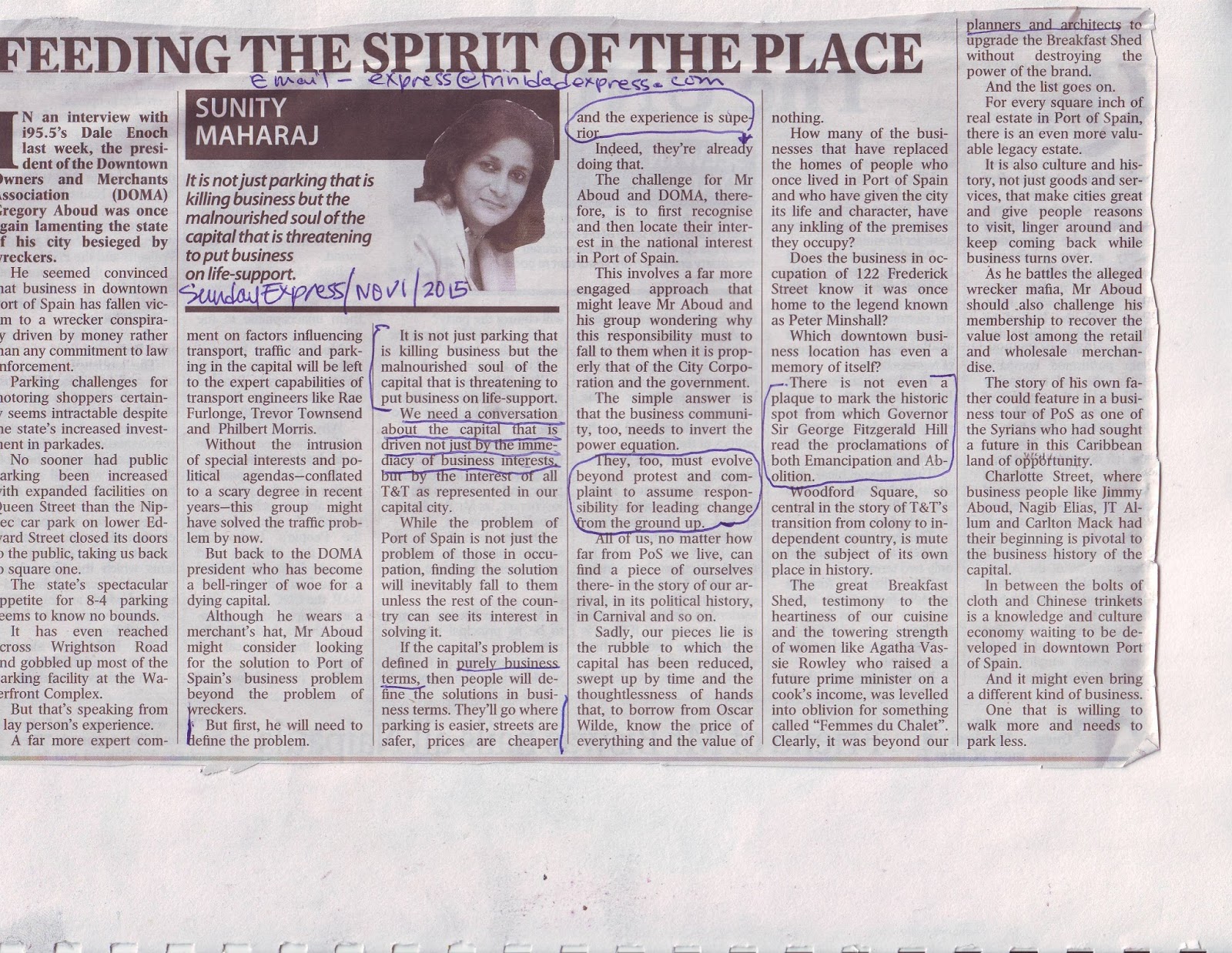
Maharaj – FEEDING THE SPIRIT OF THE PLACE, Sunday 1 November, 2015
·Harvard’s
“Black in Design” Conference: Addressing Social Injustice with Design - 10/21/2015 by The Dirt Contributor
These
5 points are large exclamation marks as to why we need our artists and design
community to ingrain an art-design dialectics into our communities, as verbs,
nouns, adjectives, semi-colons... in the structural development of statements;
when engaging in our particular aesthetics as it pertains to progressive
development, in the absence of art-design vocabulary, our language have become
bombastic and confrontational as we step towards modern development, there is
this myth that development is a curse on life, rightly so, colonialism and post
independence development policy have corrupted the planning processes, making
our communities hotspots spaces for squatting of businesses, houses, parked
cars, erosion, unsightliness, ugliness...uncivilizing living, developing
animosities between neighbours; this can be witnessed from West Moorings to
Laventille; Laventille to Lange Park, Lange Park to Moruga, our first response
to development is to shut it down, take action, its the fear of elitisms and
elitisms in development... this brings to mind the Children’s Court, which was proposed
to be installed North of the Bhagwansign’s project, it was decried; as it will
bring criminals, even thou the proposed court was a civil court dealing with
children matters, with mediation rooms, playspaces etc. There was absoluteness
in the community resistance.
Glaringly
absent from these conversations is the community unwillingness or inability to
grasp opportunity to negotiate GREEN SUSTAINABLE DESIGN, for their communities,
to set trends of partnering with business or state creating a new paradigm in
social development.
I will quote from the
DOWNTOWN-Revitalization Inc.
“We are residents, land owners and business owners in the
Charlotte Amalie area working with the public and private sectors to create a
shared, coherent vision aimed at a series of goals leading to a revitalized and
energized town of Charlotte Amalie for the benefit of Virgin Islands residents
& visitors alike.
The Bangkok Tree House Project, proves how we can design green, blend in to the environment the memory of spaces, reclaim as we build. what it takes is a willingness to listen, learn, communicate. In these instances design sets a vanguard formula of how a community will like to see its self.
WHY?
As
we navigate the Tacarigua Sculptural Playspace Project; through its development
trajectory, the project has met with a certain amount of ambivalence among
certain peoples, whose understanding of art-design working’s in developing their spaces, protecting their
spaces in the event of unwanted development seems limited, once again an
absoluteness becomes the preferred reaction rather than dialog.
One
resident posted on my wall this comment
“Where is the Agreement of Trintoplan or any of
the relevant Government Agencies that grants a permit for any Artist or
Architect to design on the Open Space of the Orange Grove Savannah. If
Trintoplan claims ownership or is a lessor please provide documentation. As a
resident of this area and like Mr. Murray born in this environment, yet, I
still live here. I have concerns of the physical use of any structural
sculpture on this open space and the psychological impact of the theme and
essence of the Art in relation to generations and their Heritage relative to
the Tacarigua Orange Grove Savannah. Urban philosophical art and design
language may have its place and rightly so but in this once rural agricultural
village our Heritage needs to be preserved.”
(Trintoplan
allowed us to use their space as good corporate, community citizen...but was
seen as authority and we must mistrust authority;
In
the absence of understanding design or design projects; underestimating what is
preservation, the village and heritage; we get confrontation...)
Art-Design
has embraced a theology of people and environment, working in congruence with
both the social and the environment, in Trinidad and Tobago that vocabulary
have not reached our architects or designers, they mention their clients; as a
hindrance to sustainable, greening architecture, rather than guiding the client
to this new vocabulary. I could remember Dr. Bhoendradatt Tewarie, the former
Minister of Planning, lamenting how they had to cajole a developer to place of
most things, trees!! Into their project.
In
the absence of this language of synergy and symmetry, we end up with a
confrontational posture. I have always wondered where this comes from,
Professor
Gerard Hucthinson – in Dr. Jean Antoine’s article, lends some insights – Trinis have trust
issues – Newsday,
Sunday March 29 2015 page 43
“We have become so adept at surviving
that we automatically assume a mask. In fact after generations of protecting
ourselves through this shield, we no longer know what is the mask and what is
the self. In effect what Professor Hutchinson is suggesting is that as a people
we have had to deal with adapting ourselves to being first of all positions of
subordination during periods of enslavement and indentureship. Subsequently we
had to adjust to new power relations after independence.
The
problem is that having lived for generations in scenarios where survival
demanded that we hide who we truly are and mistrust those in authority, we are
now not able to trust anyone.”
This
spells a death to innovation and possibilities, in communities where language
is absent, engaging with development becomes controversial and myopic, groups
who fight against authoritarianism development, in themselves create authoritarian
development, knighting themselves authority, within the rubrics of groups
dynamics, their development becomes idealized, their absoluteness resolved in
the patriarchal order of defending honour.
FEEDING THE SPIRIT OF THE PLACE
In
Sunity Maharaj’s article – FEEDING THE
SPIRIT OF THE PLACE – Sunday 1 November
2015 , Which looked at the state of the capital
city, Port of Spain, I’ll quote – “But first, he will need to define the
problem. It is not just parking that is killing business but the malnourished
soul of the capital that is threatening to put business on life support. We
need a conversation about the capital that is driven not just by the immediacy
of business interest but by the interest of all T&T as represented in our
capital city”
This
points us towards a solutions position, where art-design can raise its head as
a solution in defining the problem and developing the “malnourished soul” or
creating the “business interest” or “community interest” or “individual
interest” that is needed to support the redevelopment needs of a space, for all
its peoples, not just a few but as Sunity claims;
“the interest of all
T&T as represented in our capital city”.
Or
“the interest of all
T&T as represented in our Orange Grove Savannah”
Or
“the interest of all
T&T as represented in our communities”
First
we’re dealing with a savannah, for this argument I’ll call a space, and
space has rights!
Space
also has a right to be of and for the peoples who make that village and the
heritages of that village.
If
we go back to the “malnourished soul”
as referenced by Sunnity, I’ll say many of our spaces are “malnourished souls”
never developed to the potential of the village or the heritages of the
village...patriarchal development was and is still the signifying order of our
development (patriarchy sits within the paradigm of authoritarianism) there was
no conceptualization of babies, children, women, differently-able, the aged in
our spacial conceptualization.
So
we can say we have never nourished our spaces to its full potential, as implied
in our constitution, “every creed and race has an equal place”.
So
I’ll say in full confidence our spaces are undemocratic and unconstitutional,
authoritarian, adult oriented, unappealing, therefore violating the rights of
space and the humanity of living to our full potential.
In
this regards I’ll argue with the above statement, that art-design have the
right to be part of space, as it is in the context of social anthropological
art-design, we can achieve a social cohesion as expressed by
DOWNTOWN-Revitalization Inc.: - “public and private sectors to create a shared,
coherent vision aimed at a series of goals leading to a revitalized and
energized town”
Rowley
and Cazabon. In
the article – Rowley buys paintings, by Sean Douglas, the Prime Minister of
Trinidad and Tobago, Dr. Keith Rowley, acquired a number of paintings by
Michael Jean Cazabon, 1813-1888, which went up on auction at Christie’s,
London. In the article we hear a Prime Minister, speaking openly about “the
philistine nature”, “national heritage” and “cultural nature”,
Quote
–
“Trinidad and Tobago has brought back
its heritage of those Cazabon paintings”. Saying that another auction of
Cazabon paintings will be held next week in London, he signalled an intent to
purchase by dexlaring that if a people cannot defend their cultural heritage,
they are not worthy of nationhood.”
-Unquote
In his first post election victory speech, the
newly appointed Prime Minister of Trinidad and Tobago’s first major act was to
acquire lost paintings of our historical landscape, our memory, which will be
presented to the nation in a national exhibition for the 2016 independence
celebration. This investment is alleged to be around $3 million TTD. As
I listened to the response on Power 102.1FM radio, the response to the investment
was half and half; those who understood the importance of heritage and memory
and others in absolute opposition.
The “Harvard’s “Black in Design” Conference: Addressing Social
Injustice with Design”
Harvard University Graduate
School of Design (GSD)’s first Black in Design conference, which was sold out,
is a particularly important as a “Black” and “Brown” country as it brings to
the forefront this phenomenon of design in negritude or coolitude (as I learnt
in the Indo Caribbean Symposium), as the students expressed.
“Addressing social
injustice through design starts with two steps: revealing “the histories of
under-represented groups in design,” and acknowledging that designers have a
responsibility to “repair our broken built environment.” Also identified in the conference was and is,
exploitation, absence, treatment of a minority peoples in the development of
our spaces. This erasure is being addressed by a white and black consciousness
within the design community, at least at Harvard’s; they’re innovating,
recognizing and developing in marginalized spaces this consciousness, this
consciousness is being received by communities, why? I’m of the feeling that
these communities have recognized this absence, they have seen their
malnourishment...what it has done to them and a people who recognizes their
thirst, and they’re willing to drink from the pool...
“Dümpelmann spoke of the need to revise
landscape history to include African-Americans and women, and topics like
segregation, emancipation, and multi-racial landscapes. “Survey classes,” she
stated, “need to address race.” She cited just a few topics worthy of study,
including Frederick Law Olmsted’s “Negro Parks” in Birmingham, Alabama; park as
tools of racial segregation; and the spatial layout of plantations.”
It
was stated, if we expanded the definition of the designer while revising
history, we’ll be able to undo marginalization of the black and colored peoples
Conclusion
On
a social and political level the protection of space and heritage is on the
table...what is the disturbing is the relationship of the conversation, the
constituents, communities are arrogant, ignorant, and angry at a political
system which has created this atmosphere through corruption and undisciplined
behaviour, architects, planners, designers and artists community are silent or
not in synergetic relationship in creating language; how can we come to that
special position of understanding how we can deconstruct this material
consumption philosophy or the internal cynicism towards design development .
I’m at a point in understanding, from a theoretical, philosophical and
political consciousness, social art-design possibilities in modifying our
behaviour, I see art-design in educating, elucidating our space, our modernity,
while preserving the sugar cane plantation in us all.
“
Memory Design – is the recognition
of the historical realities of space, people, architecture, and the objects’
new desirability in achieving harmony in communal spaces. To achieve this
theoretical understanding, will mean exploring our communities past, eventually
capturing it in iconographic symbolic meaning. These symbols or our past will
be imprinted onto the object, at times directing how the object is defined,
becoming the object themselves.
Designing
from memory has the possibility of revolutionizing the desirability of the
consumer-able design product. Challenginghow production, imperialism and capitalism can operate within a space, a
community and nation. Designing within memory holds the possibility of evolving
new paradigms for art, sculpture, architecture and design; which in turn can
create greater opportunities in healing spaces with traumatic histories, spaces
at risk, space looking to capitalize on its rich stories, people looking for a
modern identity through branding and economy”
The
Prime Minister mentioned the protection of heritages, he didn’t mention the
upgrading of the system which protects and develops heritages, why do I have to
hear from the Prime Minister, that he! protected paintings; we should have
ingrained independent working systems to preserve and develop heritages. What
is happening is a parallel conversation, which needs to be synchronized within
the political, the social and the theory of the social art-design proposition.
Then we can feed the malnourished soul space, sustainably and consistently.
The
art-design community which I belong, needs to be more proactive in this dialog,
stop being separatist in our actions in development of theory, individualist in
our organizations, classist in our conversations, fearful of power, fearless in
our pursuit and be true to the political and philosophical mooring of art-design
to our development of a national regionality innovative language.
The
plastic arts and design have a contested relationship, in conversations with my
design colleagues on new hybrid possibilities of art and design in our modern
society; I have found resistance to the creation of a mix characterization of
art and design, although our modernity have witnessed an emergence of an
international design practice, where the psychoanalytical properties of art
have merged with the logic driven design; creating a nebulous innovative
environment for the practice. Artists and designers have emerged new operational
modules, challenging language vibrations; operating more fluently into
indigenous spaces, also challenging the philosophical rational of this new
performance.
.
I
make these observations as an art-designer, whose interdisciplinary practice;
have seen projects developed through the merger of both the psychological nuances
of art and design. First the craft of jewelry at John Donaldson Technical
Institute; were I confronted the industrial art of crafting metal and the
wondrous properties of metal and fire – Industrialism, at the Language of
Art Environment; I met artists Edward Bowen-painter, Chris Cozier-graphics/printer/writer,
Steve Ouditt-designer, Irene Shaw-painter – in this period I found the
confidence of the artist in developing the unconscious to conscious aesthetics,
Confidence
of the Unconscious and Conscious Practice, at University of West Indies-
I was able to develop further my understanding of the politics aesthetics,
through conversations with peers in the hallways and bars of UWI – Political
Aesthetics and Activism as practice, at the Ontario College ofArt and Design University, Toronto, I was
able to re-enforced the critical and analytical strength of the presentation,
objectification, materiality and environment..Critical Thinking in Practice.
This
rational of product making or aesthetics, is hard to quantify as it sits deep
in the centre of development or psychology of design; where design is placed in
this logical, processed form of thinking about materiality, objectivity and
market; which can be both people and economic, the merging of these two forms
bring a radical approach to materiality, marketing, economics etc.; at the same
time deconstructing the sacredness of monolithic thinking, while embracing
abstraction and free form making as a progression of logical design thought.
“Design history is
the study of objects of design in their historical and stylistic contexts.
Design history has had to incorporate criticism of the 'heroic' structure of
its discipline, in response to the establishment of material
culture, much as art history has had to respond to visual
culture, (although visual culture has been able to broaden the subject area
of art history through the incorporation of the televisual, film and new
media). Design history has done this by shifting its focus towards the acts of
production and consumption.”
What
has been done is pit design into consumption theology in the act of production
and marketing, in a very technical language, which has become very separatist,
this attraction to material culture, which designers have hinged this hierarchy
or hegemony to, while disregarding that art has these same formulas is somewhat
invalid and misleading. As we belong to a cultural ancestry of fluid dynamism,
which was able to merge material thinking, the industrial and the abstraction
of intellectual aesthetics... forming one thought of a spiritual, social,
political and economic communal functionality; our Amerindian, African, Asian,
Middle Eastern and East Indian ancestry (for now I’ll leave the European out,
but if we also look into their history we’ll find this merging), all have these
specific formulas of art and design built into their natural fabric, check the
Barefoot College - . http://www.barefootcollege.org/barefoot-approach/
A
central belief was that the knowledge, skills and wisdom found in villages should
be used for its development before getting skills from outside.”
Here is the performance of science in the space of living where the language includes everything,
children, food, husband, health, when we observe how women operate, including their world into their science,
naturally designing it into their environment, in an inclusive language, rather than how men have separated that language.
The
Steel-Pan is an example of this hybridism of art and design; from memory; a
sustainable culture of politics, economy, marketability and industry was
developed, all playing out in backyards, suitcases and intellectual dynamism,
through the act of art or the performativity of active social art-culture.
OK,
let’s WIKI . Define art
Courtesy - musical-instruments.novica.com
Observation of the Djembe Drum we will see some of the same performance of a practice,
which in retrospect we will call art, form making, performance, spiritual, communal-
this was interwoven into the role of community, tribe...now village, town, city,
where language and meaning have been lost in the high rise of gangster capitalism
“Art is
often taught through drawing, an empirical activity which involves seeing,
interpreting and discovering appropriate marks to reproduce an observed
phenomenon.”
I’ll
like to add that art is the ephemeral, emotive act imprinted into a political
symbolism of culture. This is the Steel-Pan., which are gestures of
communalism, memory of performance,
emotions,
space, liberty, finally finding symbolism, through an industrial process, to
express their art, finally finding form, sculpture; all sculpted differently
from village to village, yard to yard; pounded into a language of art, which we
will can call industrial design, which it isn’t.
courtesy - www.caribben-steel-drums.com
when we look at the performance of the making the Steel Pan,
we see the same sculptural format in making the Djembe Drum
I
understand this merger of form making, so I can’t comprehend, why? In Trinidad
and Tobago with these considerations of the ancestral idiom of practice; there
is this need to separate form making or marking. Design theory has fitted well
into the neo-liberal aspiration of state; design theory is being placed at the
feet of political jargon in the attempt of finding favour in development as a
preferred syllabus in the innovation and diversification discourse.
courtesy - www.toucans.net
what has happened is the language is separated and people are told that you're an engineer, a designer,
hierarchy is developed and specifics are set eliminating the traditional inheritance of this knowledge,
so young men who may have inherited this scientific knowledge, feel they are not worthy.
The academism of knowledge can create elitist spaces, where we leave out other innovators
This
separatism is not in the interest of development as it falsifies the act of
creation, innovation and intelligent design. Innovation comes from the
emotional deliberation of line making/marking from the cerebral to the
hand...to the line of objectivity, in this process art and design comes in and
out in a seamless conversation or research between the maker and the objective,
this conversation is had with a constituents of wife, paddner, lawyer,
economist, in the private and public spaces; stoops, offices, blocks, malls
etc. from books to the emotive naive act of creation. All playing a role in
developing authentic creativity, marking, investing, critical thinking,
One isn’t art, one isn’t
design...one is living.
When
we understand that it all hinges on the critical thinking aspect of living, we’ll
then support an innovative atmosphere, empowered towards national development,
from doctor to garbage person and in the end the artist as a people, in this
aspect – Innovative Education
Marlon Darbeau http://marlondarbeau.blogspot.com/
Re-Development of the Peera Stool,
is a prime example of how a designer can assist in the development of art and craft.
The re-imaging of a normal object, which would have been crafted through skilled and unskilled hands
to work out a need, in a designers hands there're certain specifics that are taken into consideration to
bring the project to objectivity. Design has changed to engage social design, where the social designer
is more observant of people, behavior - thus the designer has become a anthropologist, psychologist, sociologist
THE HDC, HOUSING
DEVELOPMENT CORPORATION DEBACLE IN CONSUMING AESTHETICS...
“ DEBE HDC residents
protest...home renovations for our safety and comfort” – it
seems that HDC sent letters to residents who added additions to their homes,
that it was illegal and they had 28 days to remove all illegal addition. This
has created a conversation about management, service, form and finally
aesthetics...although not one word of beauty has been offered.
From
the article there are –
“Mohammed added: “There were a lot
of people that did not get the approval to do these things but they are
securing their place. You can’t wait till it gets in your house to go to put up
something. Some people have little dogs outside as a form of protection,
because they would not have gotten approval or they don’t have the finance even
to fix their properties.”
HDC
RESPONSE – Maurisa Findlay, HDC Manager of Corporate Communication –
“She said, “We meet with communities
all the time but the HDC apparatus for monitoring for maintaining order,
improving security enduring that there is discipline, for ensuring that there
are standards in our community will continue to work, that apparatus, we are
not easing up on that.”
Maurisa
went on to say.
“Even if they believe that there are
things we must do their unit and that is very subjective based whether or not,
they are homeowners, they are tenants there is still that responsibility to
uphold the rules and regulations of the organisation. Those rules and regulations
of the organisation is not to be flouted. It is to endure that there is a
standardisation in the way in which we want our communities to appear and we
want people to live.”
This
is also good to note –
“She said renovations and defects
were different issues and would be dealt with separately.”
SUNDAY
EXPRESS-27 SEPTEMBER 2015, 11PG
Here
is a prime example of having a serious conversation about art-design in the
living; Art - as the people
innovating, developing space from an emotional position, becoming an eye soar
and aesthetic issue to the living quality of other like minded residents who
share these spaces, due to poor craft skills, I’m sure contractors not aware or
fully versed in the language of aesthetics. Design - is the implementation of the heart of peoples, “design”
manages “art” through critical conversations specific to that space; its
politics, social authority, economic.
In
the article you witness the bureaucratic language of design, which keeps us in the
brutish norms of colonialism...
·“standardization”,
·“rules”,
·“regulations”
·“organization”
Not
one word of beauty, aesthetics...there are the words “Community to appear” and “live”...
What
is interesting in this article; is how divorced authority is to the language of
beauty, how authoritarian we have become from an education, which have created
robots, built for industrial work, orders and commands. There is no softness in
power, in understanding both the authority and the management of beauty - Art.
There
is natural right of the proletariat; to an innovative education, encouraging
the natural instinct toward intellectual thought of the mind, to the
instinctive craft and skill of the hand; merging the academics of life,
evolving child to man to woman as an all inclusive conscious aesthetic
property.It’s a clear attitude of
socialist norms...but its more than that, it is the natural anthropological
behaviour of all humans to behave in such a manner, it’s our inability to
control the language of capitalism, which has created this ambivalence towards
space and behaviour.
What
is needed is the designing of art into the living of these spaces, art-designing
how people manage these spaces, it is not enough to say that there’re are
resident associations leaving it like that, we must art-design how these association
operate, the social implication of roll out is important in the social
art-designing of living spaces. At this point HDC spaces are just designed,
this is the issue.